
more photos of Jazzmatazz
aufmerksamkeitsoekonomie © Barbara Mürdter 
About the omnipresent racism: An interview with Frank Castorf and his Brazilian actors that the staged in the South American country song "Black Angel" now as a guest performance in Berlin show
In No other country the world are the breed mixed in Brazil. After the late abolition of slavery (1888), there was never an official segregation. Stefan Zweig swarmed mid-20th Century: "It is touching to have the children adapt to all shades of human skin color - chocolate, milk and coffee - to see it coming arm in arm from the school." But what is public can not be named, as shameful and bad manners, reflected in statistics and everyday experience: Brazilians with African ancestors, the worse cards have in life - due to lack of educational opportunities, a higher rate of violence but also of prejudices that are already in the kindergarten education created, because it includes the teachers and teachers deal with children differently than white and black. The bitterest: The Afro-Brazilians themselves have internalized these negative stereotypes.
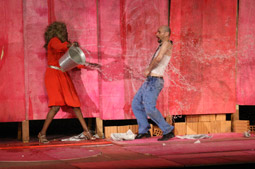
Ismael tortures his wife out of hatred for his skin color - A scene from Frank Castorf "Black Angel"
parable on race relations
The black self-hatred and the underlying racial problems were popular in 1946 by the Brazilian writer Nelson Rodrigues in the play "Black Angel" taken up. In his parable about the racial ratio in his country, he describes a black physician who is white too full of self hatred and the desire, raped a white woman. He marries, and the woman brings her hand on a regular basis in their hatred to their half-black children. The characters are caught in a cycle of mutual dependence.
Castorf Frank took up the controversial document and was engaged for a production in Sao Paulo, after he had listed there are "Jungle of the Cities". Time of its construction is the substance have been scandalous, full of taboos, says Castorf. Not only because of the sexually-pornographic side of the piece and the offensive approach to racial issues, but also because the main character was a black man: "At that time had to be the be played by a white actor who was black makeup." Because he Rodrigues' play but was too nihilistic, be added Castorf it with pieces of Heiner Mueller's "The order "- a play about the failed attempt by the export of the French revolution to Haiti. He wanted to show that "may change some people in certain situations the world."
A Brazilian author, a German author and the subject of racism
The author Nelson Rodrigues is a bar healer of Brazilian culture, almost a little boring for the locals. An actress says: "We were fascinated Castorf subversive use of the Rodrigues text. The self-in-the-other-empathy, to understand it, comes in the original is not available. "The actors are in turn largely unknown in Brazil by the miller and his involvement with the uprising in Haiti have been done, because they identify content could, if there was a black man, for example, says, "I said, slaves have no home. Not true. The home of the slaves, the insurgency. "And in another monologue, the term raises the slave to a level beyond the race on the Out of the hives.

"Whether you are referred to as Afro-Brazilian, is a political decision": A young actress from Castorf team reviewed their appearance
That the issue of racism, the Castorf here negotiated on an abstract aesthetic level, in the Brazilian society is highly relevant, both my Castorf and his Brazilian actor. "Racism in Brazil is much current as it refuses to acknowledge the official intellectual Brazil," says the director. At the moment there was a heated discussion about quotas for black students at universities. Currently, only 4% of students are Afro-Brazilians, with a Population of almost 50%. Further reports Castorf: "While Sao Paulo is still quite enlightened, you have to go to Salvador only once - there are the living conditions not unlike some parts of Africa. There is an extreme inequality. You can tell because the extreme importance if we say let us unite it and make something different. "
" In the Brazilian theater system there are seldom so many blacks on the stage "
As Castorf looking young black actor, was find it at the University of Sao Paulo. He held talks and met with several students on the black theater group "Filhos de Olodum ". "This was the first time that they have so established an Afro-Brazilian group and expressed openly that they have other interests than the others," says Castorf. Gal Quaresma, a member of the group, says: "We have sat down and discussed what it means to be black, what we want to talk specifically as an Afro-Brazilian actors, as we want to be an actor. And as we face the fact that it is harder than black, to live as an actor. "The political attitude to the issue of racism was an issue that Castorf, who had considered working with professionals, convinced to engage the drama students.

Castorf occupied "white" roles black and vice versa
Even today, "we find it rare in the theater being in Brazil that many black actors on the stage," Castorf said in view of its staging. The black actress and singer Denise Assunção Castorf has in mind for the lead role of white Virginia "wrong" busy - so just as the black main character Ishmael is played by a white man. Denise Assunção confirmed the impression that disproportionately represented in the Brazilian media in general White and would blacks were mostly seen only in stereotype roles. She adds: "It's getting a little better." Assunção has since the late 60's on stage. It must, however, until today because of her looks, which does not match the current beauty ideals of (white) femininity, often take other jobs to survive, "If you're black and it has a broad nose and thick lips, apply it as unfeminine . They seldom are lucky, a director it just because of the "other active" appearance.
"A laugh about their own pain"
In Brazil , the stage play "Anjo Negro" as "Black Angel" in the original is, although it is so painful and brutal, energized the audience in part, a certain serenity, "It was more of a laugh out of discomfort of being confronted with things which we suppressed. And a laugh about their own pain - can take place like this. And because there is no pure race in Brazil, is any kind of a bit of a hit and laugh, too, "say the actor. Recently, the festival of theater in Hanover as a guest is Frank Castorf "Black Angels" today and tomorrow as part of the Brazilian week to look at the adult stage in Berlin.


 Photo: Wikipedia / Calton
  Photo: Wikipedia / Daniel Schwen
 Although the Congo Free State was not officially a Belgian colony, Belgium was its chief beneficiary, in terms of its trade, the employment of its citizens, and the wealth which Leopold extracted which was used for the construction of numerous fine public buildings in Brussels, Ostend and Antwerp. This led to him being remembered in Belgium today as the 'Builder-King'. Through the Royal Trust he left most of his property to the nation.


